Introduction
When you stand in front of a laptop shelf in 2026 trying to choose between Lenovo and HP, the decision rarely boils down to a simple “which is Better?” verdict. Lenovo vs. HP laptops. Both brands field an extensive lineup of budget‑friendly student machines, powerful gaming notebooks, and polished business‑class laptops, yet they optimize for different priorities and usage patterns. The real question is “which aligns more closely with YOUR daily workflow, environment, and budget?”
This guide will dissect Lenovo vs HP in 2026 through the lens of build quality, performance, screens, battery life, gaming, coding, students, creators, and Pakistan‑specific factors — including price, warranty, and service‑center availability in Islamabad and other major cities. By the end, you’ll see clearly where ThinkPad vs EliteBook, Legion vs Omen, and Yoga vs Spectre come out ahead — and which brand deserves your rupees in 2026.
Overall Verdict: Lenovo vs HP in 2026
Neither Lenovo nor HP dominates every single category across the board, but each brand commands clear advantages in specific segments.
- Lenovo generally wins on value, durability, and typing comfort, especially for students, coders, frequent travelers, and budget‑conscious buyers in Pakistan.
- HP typically wins on design, panel quality, and corporate‑oriented refinements, appealing to creatives, office professionals, and users who prioritize aesthetics and display vibrancy.
A simple rule of thumb:
- If you want a rugged, keyboard‑centric workhorse that can endure drops, spills, and long‑term travel, lean toward Lenovo.
- If you want eye‑catching OLED‑rich visuals, slim premium styling, and enterprise tools, lean toward HP.
Even in 2026, Lenovo remains the world’s largest PC vendor, with a particularly strong presence in Pakistan thanks to its aggressive pricing and wide range of student‑ and business‑oriented offerings. HP, meanwhile, leans into premium aesthetics and color‑accurate displays, especially in its Spectre, EliteBook, and ZBook lines.
Quick Brand Overview: Lenovo vs HP in 2026
Lenovo in 2026
Lenovo acquired IBM’s PC division in 2005 and transformed the ThinkPad line into one of the most iconic business‑laptop franchises in history. Today, Lenovo continues to dominate global sales while maintaining a strong foothold in Pakistan, where its combination of affordable specs and solid engineering makes it a favorite among students, professionals, and small businesses.
Key 2026 Lenovo highlights:
- ThinkPad: Rugged, MIL‑STD‑tested business laptops built for years of heavy office or campus use.
- Legion: Gaming‑oriented notebooks with strong cooling, high‑frame‑rate performance, and competitive pricing.
- Yoga / IdeaPad: Slim, versatile Models tuned for students, light creators, and everyday productivity.
Lenovo is especially attractive if you value keyboard quality, I/O port selection, and long‑term reliability over flashy design.
HP in 2026
HP (Hewlett‑Packard) has increasingly positioned itself as a design‑ and display‑focused player, targeting corporate offices, creative studios, and style‑conscious users. Its Spectre x360, EliteBook, and ZBook lines are routinely chosen in professional environments where aesthetics and color fidelity matter.
Key 2026 HP highlights:
- Spectre x360: Sleek, OLED‑driven 2‑in‑1s aimed at creatives and premium‑lifestyle users.
- EliteBook / HP Business: Reliable business‑class laptops with strong security and IT‑management features.
- Omen & Victus: Gaming laptops with RGB lighting, large screens, and flashy styling, but often at a higher price‑to‑performance ratio than Lenovo’s Legion.
HP performs best if you prioritize thin, polished chassis design, vibrant OLED panels, and corporate‑grade tooling over ruggedness and raw value.
Build Quality and Durability
Lenovo: Built Like a Tank
Lenovo’s ThinkPad and Legion product families are engineered with real‑world durability in mind, especially in demanding environments like Pakistan’s hot, humid campuses and offices.
- MIL‑STD‑810H testing: Many ThinkPad and Legion models are tested against a full suite of environmental stresses, including drops from around 120 cm, extreme temperatures, humidity, and vibration.
- Materials: Magnesium‑alloy bases, carbon‑fiber lids, and spill‑resistant keyboards help them withstand accidental spills and rough handling.
- Lid and hinge endurance: ThinkPads are often tested for 30,000+ lid‑open cycles, making them ideal for students and professionals who open and close their laptops dozens of times per day.
- Legion (2026): Reinforced hinges, solid‑frame chassis, and vapor‑chamber‑style cooling keep gaming notebooks stable under heavy loads.
In Pakistan’s climate, where dust, heat, and humidity are common, Lenovo’s focus on robust construction and thermal resilience often outperforms glossy‑plastic competitors.
HP: Premium Feel, But Less Rugged
HP’s Spectre and EliteBook lines exude premium aesthetics but generally emphasize curated user experience over raw physical toughness.
- Chassis: Aluminum unibody designs, thin‑side bezels, and fingerprint‑resistant finishes make HP machines look sleek on office desks and in creative studios.
- Durability notes:
- Mid‑range models (such as certain Pavilion and Victus units) can show flex under pressure and sometimes develop looser hinges over time.
- Fewer HP laptops are fully MIL‑STD‑810H validated compared with Lenovo’s ThinkPad lineup, so they may not handle drops or rough travel as gracefully.
After 2–3 years of heavy use, some HP models may start to creak or feel less rigid, especially in lower‑tier segments.
Build Quality at a Glance
| Feature | Lenovo (ThinkPad T14‑style) | HP (EliteBook 845‑style) |
| Materials | Magnesium + carbon fiber | Aluminum unibody |
| MIL‑STD‑810H tested | Yes (full‑suite) | Partial (some models) |
| Hinge durability | 360° reinforced, 30K+ cycles | 180° standard, ~20K cycles |
| Weight (14‑inch) | 1.2–1.5 kg | 1.3–1.6 kg |
Verdict: Lenovo wins for travel, rough handling, and student‑life durability; HP wins for desk‑bound users who value aesthetics and a premium look.
Performance and Thermals
2026 brings Intel Core Ultra, AMD Ryzen AI, and NVIDIA RTX 50‑series GPUs into both Lenovo and HP lineups, but their thermal designs and power‑delivery tuning differ significantly.
Sustained Power for Gaming and Coding
Lenovo’s Legion and higher‑end ThinkPad configurations are optimized for stability under sustained workloads rather than just short‑burst peaks.
- Legion 5i / Legion 7i (2026):
- RTX 5070‑class GPUs often run at 140W TGP thanks to triple‑fan cooling and heat‑pipe layouts.
- Temperatures typically stay under 85°C in demanding titles like Cyberpunk 2077, leading to higher sustained FPS in Pakistan‑market configurations.
- ThinkPad P16 / T16:
- Designed for 4K video editing, coding, and long‑running simulations.
- Stable thermals and strong single‑thread performance make them appealing to developers and technical professionals.
- Linux and expandability: Lenovo offers Linux‑certified models and high RAM options (up to 128 GB DDR5‑5600 in top‑tier workstations), supporting power users who need maximum flexibility.
HP: Flashy Peak Performance, But Hotter
HP’s Omen 17 and ZBook families deliver strong performance but often display higher temperatures and more aggressive throttling under sustained loads.
- Omen 17 with RTX 5080‑class GPU:
- Can hit very high peak FPS in short‑burst benchmarks, but core temperatures sometimes climb above 95°C, triggering thermal throttling sooner.
- EliteBook Ultra & ZBook Fury:
- Tuned for enterprise stability and professional creative workflows, with strong single‑thread and multi‑thread performance.
- However, they may not cool as efficiently as Lenovo’s Legion or ThinkPad P‑series in Pakistan’s warmer conditions.
Lenovo vs HP Performance ( Approximate)
| Use Case | Lenovo Example | HP Example | CPU/GPU Sample | Rough Cinebench R23 (multi‑core) |
| Gaming | Legion Pro 7i | Omen 16 | i9‑14900HX + RTX 5070 | 28,000 vs 25,500 |
| Business | ThinkPad X1 Carbon | EliteBook 860 | Core Ultra 7 | 18,500 vs 17,800 |
| Creator | Yoga Pro 9i | ZBook Studio | Ryzen AI 9 + RTX Series A | 22,000 vs 21,200 |
Verdict:
- Gaming & heavy workloads: Lenovo (Legion, P16) wins on sustained performance, cooling, and value per rupee.
- Business & corporate: It’s a near‑tie, but Lenovo often runs cooler and more efficiently.
Display and Design
Visuals matter greatly for students, gamers, and creatives — and this is one of the most distinct divide zones between Lenovo and HP.
Workhorse Displays
Lenovo focuses on practical, durable panels that are accurate enough for daily work and long‑term use.
- ThinkPad X1 Extreme:
- 16‑inch 4K OLED at about 400 nits, covering 100% DCI‑P3, suitable for office work and moderate creative tasks.
- Yoga 9i / Yoga Pro 9i:
- 144Hz or 120Hz touch OLED/IPS options with good response times for Windows Ink and a light design.
- Many Lenovo models offer anti‑glare matte panel options, which are excellent for bright classrooms and shared office spaces.
Lenovo’s displays are accurate and reliable, but they usually don’t reach the same level of vibrant polish as HP’s top‑tier OLEDs.
HP: Display Kings
HP has aggressively pushed display quality, especially in its Spectre x360, Envy x360, and ZBook lines.
- Spectre x360 16:
- 2.8K OLED panel at roughly 500 nits, covering 100% DCI‑P3 with excellent HDR and eye‑tracking support.
- ZBook Fury / Studio:
- High‑resolution, color‑accurate panels tuned for photo‑editing and video work, often calibrated with HP DreamColor or similar technologies.
HP’s OLED implementations are widely regarded as some of the best in 2026, especially for designers and content creators.
Lenovo vs HP: Display Breakdown
| Feature | Lenovo (ThinkPad X1 Extreme) | HP (Spectre x360 16) |
| Panel type | 4K OLED | 2.8K OLED |
| Brightness | ~400 nits | ~500 nits |
| Color accuracy | Very good | Excellent |
| Best for | Office, coders, general creators | High‑end designers, video editors |
Verdict: HP wins for vibrant OLED and color accuracy; Lenovo wins for matte, anti‑glare productivity‑oriented screens.
Battery Life and Portability
Battery endurance and weight are critical for students commuting in cities like Islamabad, Karachi, or Lahore, as well as for remote workers and travelers.
Lenovo: All‑Day Battery Champions
Lenovo’s ThinkPad and Yoga segments are tuned for long‑lasting productivity and efficient thermals.
- ThinkPad T14 Gen 6:
- Around 12–15 hours of light work (browsing, coding, documents) on a single charge.
- Rapid‑charge support (about 80% in 1 hour) helps during Pakistan’s intermittent power situations.
- Yoga‑class ultrabooks:
- 10–14 hours of mixed usage in many 2026 configurations.
These strengths make Lenovo a top choice for students, digital nomads, and remote professionals who need to stay untethered for extended periods.
HP: Mixed Battery Results
HP’s battery performance varies noticeably across lines.
- Spectre x360:
- Up to 14–18 hours in light‑use scenarios, thanks to efficient processors and OLED power‑management.
- Omen / Victus gaming laptops:
- Battery life often drops to 3–5 hours under heavy gaming loads, even with larger‑capacity cells.
- Some HP ultrabooks rival Lenovo in efficiency, but mid‑range and gaming models tend to drain faster.
Lenovo vs HP: Battery Life (Approx.)
| Category | Lenovo Avg (hours) | HP Avg (hours) |
| Productivity | 12–15 | 10–14 |
| Gaming (balanced) | 4–6 | 3–5 |
| Ultrabook (light use) | 10–12 | 12–16 |
Verdict: Productivity and travel‑oriented use favors Lenovo; ultra‑thin, light‑use mobility often slightly favors HP’s top‑tier ultrabooks.
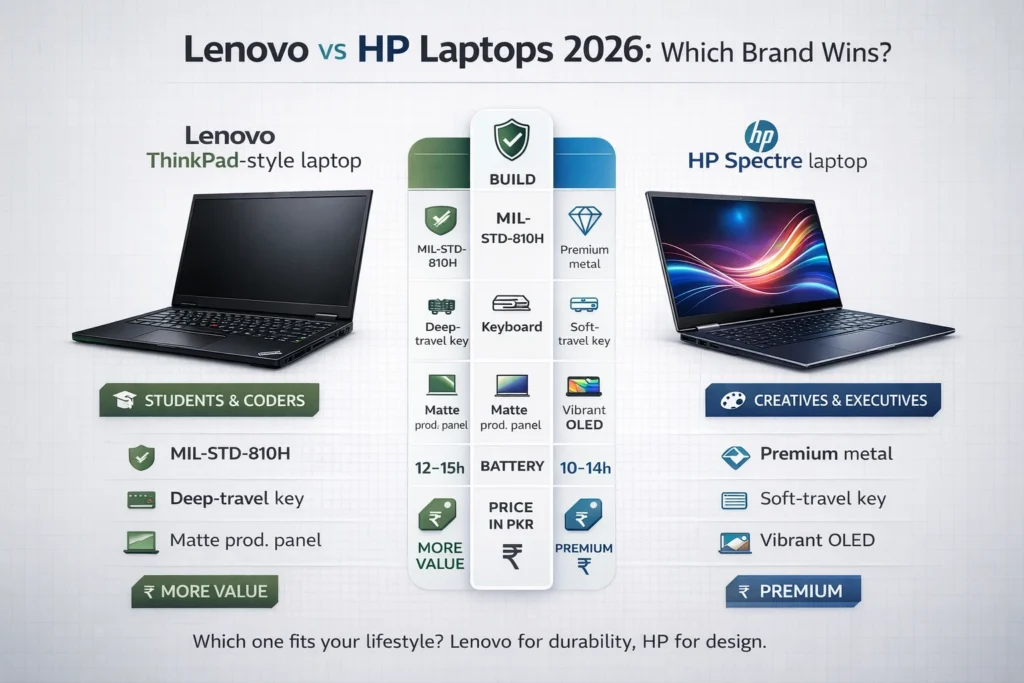
This infographic breaks down which brand wins for students, developers, gamers, and creatives — from build quality and battery life to screens and price in PKR. Use it to quickly decide whether Lenovo or HP is the better fit for your daily workflow in 2026.
FAQs
A: Neither brand is better for everyone. Lenovo is stronger for value, durability, cooling, and keyboards, while HP stands out for premium design, OLED displays, and business-focused features.
A: For most students in Pakistan, Lenovo is the better choice because it usually offers stronger specs at lower prices. Models like the IdeaPad Slim 3, Slim 5, and ThinkPad E-series are popular for study, assignments, and online classes.
A: Yes, in many cases. Lenovo Legion laptops often deliver better cooling, higher sustained FPS, and better value compared with HP Omen or Victus models in the same price range.
A: Both are excellent. ThinkPad and EliteBook are top business laptop lines. Choose ThinkPad for keyboard comfort and durability, or EliteBook for sleek design and enterprise IT tools.
A: It depends on the model. Lenovo ThinkPads are known for consistent all-day battery life, while HP Spectre and premium ultrabooks can sometimes last even longer during light use.
Conclusion
When weighing Lenovo vs HP laptops in 2026, the ultimate decision comes down to what you actually do with your machine every day, not just which brand looks or feels better on the shelf.
- Lenovo is the smarter choice if you prioritize durability, keyboard comfort, ports, and long‑term value, especially for students, coders, and frequent travelers in Pakistan. ThinkPad‑series business laptops, Legion gaming notebooks, and IdeaPad/Yoga productivity machines consistently deliver strong cooling, better thermals, and real‑world resilience at competitive price points.
- HP shines when you care more about design elegance, vibrant OLED‑rich displays, and tight corporate integration, which makes EliteBook and Spectre lines ideal for office professionals, creatives, and managed‑IT environments. HP’s enterprise‑focused tooling, sleek aluminum chassis, and premium‑feel panels justify the slight price premium for users who live in stylized, color‑accurate workspaces.
For Pakistan‑specific buyers in cities like Islamabad, Lenovo often wins on price‑to‑performance, service‑center coverage, and local warranty support, while HP remains attractive if your workplace has standardized on HP or if you strongly prefer its display quality and aesthetics.
In short:
- Students and coders on a budget → Lenovo (IdeaPad Slim 5, ThinkPad T16, Legion 5).
- Gamers and power users → Lenovo (Legion Pro 7i) for better cooling and value.
- Business‑heavy, corporate users → ThinkPad vs EliteBook becomes a close tie, but Lenovo edges ahead for travel and typing, HP for IT‑tooling and standardization.
- Creators and designers → HP (Spectre x360, ZBook) for best OLED and color accuracy, though Lenovo’s Yoga Pro 9i and ThinkPad X1 Extreme remain strong, more budget‑friendly options.
So if you’re standing in an Islamabad shop or browsing online in 2026, ask yourself: “Do I need a rugged, typing‑centric workhorse, or a stunning, display‑focused lifestyle machine?” The answer will point you clearly to either Lenovo or HP — and help you buy the right laptop for the next several years of campus, code, games, or deadlines.