Introduction
A Lenovo laptop not turning on can feel like everything suddenly stops—your work, studies, entertainment, and even important deadlines. You press the power button, expecting life, but nothing happens. No lights. No sound. Just silence.
This issue is more common than you might think in 2026, especially with increased daily usage, remote work, and heavy multitasking. The good news? In most cases, your laptop isn’t “dead”—it just needs the right fix.
Sometimes the issue is simple, like a drained battery or a faulty charger. Other times, it could be RAM, BIOS errors, or display problems. What matters is knowing how to diagnose the problem step by step instead of guessing. This guide walks you through 17 proven fixes, starting from basic checks to advanced troubleshooting—so you can bring your Lenovo laptop back to life without wasting time or money.
In this guide, you will learn:
Why a Lenovo laptop refuses to power on
How to quickly diagnose startup problems
17 step-by-step troubleshooting solutions
Hardware and software repair techniques are explained clearly
When it is time to contact professional technicians
Last stop on this full walkthrough– spottingwhyyourLenovo won’tturnonfinallymakessense. Step by step, clues add up, until the real problem shows itself plainly. Eachcheckbuildsontheonebefore, yet stands apart when answers hide in odd corners. When power plays games, method beats guessing every time. Clarity comes not from luck, but from doing things in order. Even confusing glitches fold once patterns emerge. Nothingskipped, nothingassumed- that’s what brings results.
Why Your Lenovo Laptop Is Not Turning On
A good first step? Know what stops your Lenovo laptop from powering on. Figuring out the cause matters more than jumping into fixes.
Most times, separate signs point to separate reasons behind them. Watching how your laptop acts might lead straight to what’s wrong.
Common Symptoms and Possible Causes
| Symptom | Possible Cause |
| No lights or fan activity | Power adapter failure or motherboard issue |
| Laptop turns on, then shuts off | Display or RAM problem |
| Laptop works only with the charger | Overheating or hardware failure |
| The laptop works only with the charger | Battery failure |
Dead or Faulty Battery
Laptop batteries fade with age. As months pass, these power cells slowly forget how to hold a full charge.
Around two tofouryearsishowlongmost laptop batteries keep working well – routine charging, heat levels, and daily use shape that span. Though built tough, they slow down when constantly plugged in under hot conditions. Each cycle of Draining and refilling wears them just a bit more over time. After months of steady work, performance dips quietly without warning.
Failing slowly, a battery loses its punch over time – eventually unable to kick-start the machine. Power fades, performance drops, until one day it just won’t turn on.
Common Signs of Battery Failure
- The laptop works only when connected to a charger
- Battery percentage stuck at 0%
- Laptop shuts down unexpectedly
- The device refuses to start without AC power
Battery runs out or breaks? The laptop might not start without plugging in a charger. Power stops flowing – the machine stays dark until wall energy comes back.
Fixing it might mean swapping out the old power cell. Sometimes that’s all needed to get things working right again.
Faulty Power Adapter
Most timesa Lenovo laptop failstostart, thereasonsitsinsideabrokencharger. Not every faulty power supply shows obvious damage, yet it stops electricity flow. Often, users overlook this piece because the cord looks fine at first glance. The machine needs steady voltage, something a damaged adapter cannot deliver. Without proper power, even a healthy battery struggles to respond. Sometimes wiggling the cable triggers brief signs of life. That flicker points straight back to connection flaws. Replacement chargers tend to fix these cases fast.
Frayed cords might be why your power adapter fails. Inside glitches could also kill the connection. Bumps and drops tend to mess things up, too. Faulty wiring deep within often plays a part. Sometimes it just wears out from being plugged in so much.
Possible Causes of Adapter Failure
- Frayed or broken charging cable
- Bent or damaged connector pins
- Internal power brick failure
- Overheating or an electrical surge
When the adapter fails to deliver a steady current, starting up becomes impossible for the laptop. Without consistent energy flow from the source, the operation halts before it begins. Power interruptions at this stage stop everything cold.
A faulty power source might be to blame if the laptop works when hooked up to a known good charger. Different cords sometimes reveal hidden glitches in hardware behavior.
Charging Port Problems
Fed by the wall outlet, the DC charging port links straight to the laptop’s main circuit board. Its job? Carrying energy from the plug to the system without detours. Not wireless, not internal – this small socket bridges outside juice to inside brain. Without it, the adapter sits useless, like a key that won’t turn. Power flows only when the contact clicks into place. That tiny connection keeps everything running.
Should that port get blocked or break, charging could stop working entirely. Powering up the machine might just not happen anymore.
Common Charging Port Issues
- Loose internal connector
- Dust or debris is blocking the port
- Bent or damaged pin inside the port
- Physical damage caused by force
Flickering lights might catch you here, as something is off with the charge signal. Sometimes it pulses on and off without rhythm. Other times, the light stays dark when it should glow.
Cleaning or repairing the port may restore power connectivity.
Corrupted BIOS Firmware
When a computer powers on, the first thing that runs is BIOS – this small but vital program gets hardware ready to go. It checks parts like memory and storage before anything else loads. Without it, the system would not know how to begin. This built-in software works quietly every time the machine starts up.
A glitch in the BIOS might stop the laptop before it fully starts up.
Common Causes of BIOS Corruption
- Interrupted BIOS updates
- Sudden power failures during firmware updates
- Malware infection
- System crashes or improper shutdowns
Some laptops freeze at boot when BIOS issues show up. A glitch inside can make the machine seem dead. Startup halts often point to firmware trouble deep down. Powering on might lead nowhere if the settings go wrong. Silent screens sometimes trace back to corrupted BIOS data. Errors here prevent normal launch sequences entirely.
Fixing the problem might come from resetting the BIOS settings back to default. Sometimes a full restore of those options clears it up instead.
RAM Failure
RAM checks itself each time the computer wakes up. What happens next depends on whether it passes that first test.
Faulty memory sticks can stop a computer from booting up. Sometimes they just need reseating. Other times, physical harm has occurred. Mismatched specs cause issues, too. A machine might power on but freeze instantly. Each symptom points back to the module. Not every error shows clearly. Some problems appear random at first glance.
Symptoms of RAM Issues
- Laptop powers on, but the screen stays black
- Repeated beeping sounds during startup
- System freezing during boot
- Unexpected crashes
A fresh start comes when you pull out the memory sticks, then put them back in place. Sometimes that tiny shift clears up boot trouble.
Motherboard Damage
A single mainboard ties every part of a laptop together through one core layout.
When the motherboard stops working properly, a laptop might act up in big ways, like:
- No power indicators
- No cooling fan activity
- No charging response
Common Causes of Motherboard Failure
- Liquid spills
- Electrical surge or power fluctuation
- Component degradation
- Severe overheating
Faults on the main circuit board often need expert testing tools to spot issues correctly. A technician usually handles these checks using specific gear found in repair labs.
Quick Checks Before Troubleshooting
Start by testing the basics instead of jumping into complex fixes right away.
Most people fix it by following a few simple checks. Still, some skip straight to more complex fixes without trying them first.
Basic Troubleshooting Checklist
Ensure the charger is firmly connected
Test another electrical outlet
Remove external USB devices
Check the charging indicator light
Inspect the charger cable for damage
Now here’s an idea: try plugging into another socket just to see. Or maybe it just needs a firmer connection on the charging end. Could be that easy.
Proven Fixes for Lenovo Laptop Not Turning On
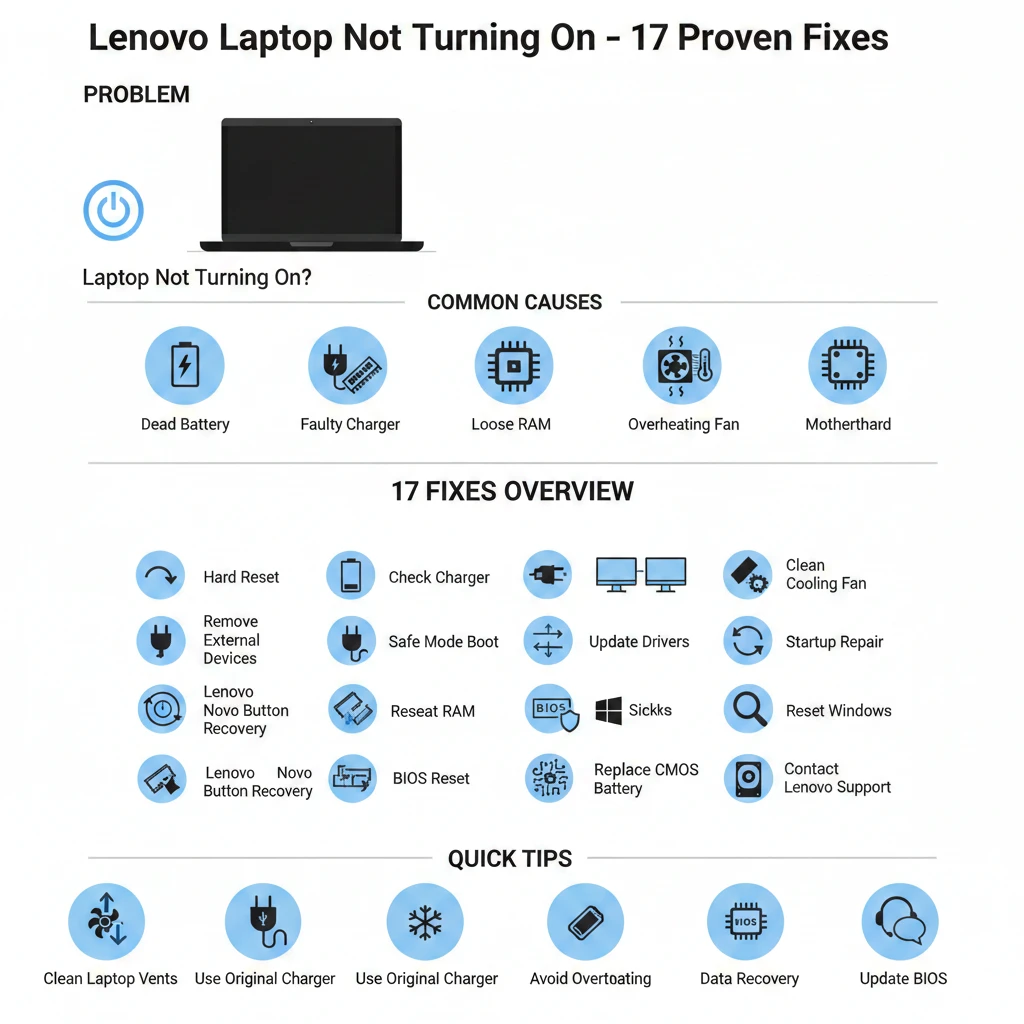
Now, let’s explore 17 effective solutions that may restore your laptop.
Start with the easiest ones, moving step by step toward the tougher solutions.
Perform a Hard Reset (Power Drain)
When nothing else works, starting over usually helps right away.
A small amount of electricity can linger in the motherboard after shutdown. This leftover power sometimes stops the laptop from turning on. It sits there quietly, unseen but active. Without releasing it, the machine may refuse to boot. Clearing this charge often helps things work again.
Steps to Perform a Hard Reset
- Hard Reset Procedure
- Wait until the screen goes dark before closing the lid.
- Unplug the charger first.
- If you can take the battery out, do so.
- A half-minute of holding down the power key is what happens next. After that long push, release it slowly.
With a sudden shift, leftover charge escapes while the system inside resets itself. Power fades out as components wake up anew.
Folks often find things working again right after trying this move. Startup issues just fade away, like magic, but without the show.
Check the Power Adapter
A dead Lenovo laptop, despite being plugged in, could point to a faulty charger.
Carefully inspect the adapter for:
- Frayed wires
- Bent connector pins
- Loose cable connections
- Burn marks or unusual heat
Try using a different Lenovo charger, if you have one that fits, just to see if it fixes the problem.
Check Battery Health
An aging battery may no longer provide sufficient power.
Battery Failure Symptoms
- The laptop operates only when plugged in
- The battery refuses to charge
- Random shutdowns
- Battery swelling or overheating
Replacing an old battery often restores reliable power performance.
Disconnect All External Devices
External devices may occasionally interfere with the boot process.
Disconnect everything, including:
- USB flash drives
- External hard drives
- Printers
- SD cards
- Docking stations
After removing all peripherals, attempt to power on the laptop again.
Use the Lenovo Novo Button
Many Lenovo laptops include a Novo button, which is an emergency recovery feature.
It allows access to system recovery tools even when Windows cannot start.
Steps
- Turn off the laptop.
- Locate the Novo button.
- Press it using a paper clip or pin.
- Select System Recovery.
This feature can restore system functionality when Windows fails to load.
Boot into Safe Mode
Safe Mode loads only essential drivers and system services.
If your laptop successfully starts in Safe Mode, the issue may be caused by software conflicts or faulty drivers.
Steps
- Turn on the laptop.
- Press F8 repeatedly.
- Select Safe Mode.
Once inside Safe Mode, uninstall recently installed software or problematic drivers.
Check the Display
Sometimes the Laptop is actually running, but the internal screen is malfunctioning.
You can verify this by connecting an external monitor.
Steps
- Connect a monitor using HDMI or VGA.
- Turn on the laptop.
- Press Fn + display switch key.
If the external monitor works, the problem may involve:
- Broken laptop screen
- Loose display cable
- Graphics processing unit issue
Reseat the RAM
Loose RAM modules can interrupt the POST process.
Steps
- Turn off the laptop.
- Remove the back panel.
- Locate the RAM modules.
- Remove the RAM sticks.
- Reinsert them firmly.
If multiple RAM modules are installed, test each one individually.
Reset the BIOS
Resetting BIOS settings can fix hardware configuration problems.
Steps
- Turn on the laptop.
- Press F2 or F12 to enter BIOS.
- Select Load Default Settings.
- Save and exit.
This restores factory hardware configurations.
Check for Overheating
Overheating can cause automatic shutdowns.
Dust accumulation often blocks airflow and increases internal temperatures.
Cleaning Tips
- Remove dust from ventilation grills
- Clean cooling fans
- Ensure proper airflow around the laptop
Regular cleaning helps maintain stable performance.
Update Drivers
Outdated drivers may cause compatibility problems during startup.
Important drivers include:
- Chipset drivers
- Graphics drivers
- Storage drivers
Updating drivers ensures proper hardware communication.
Run Windows Startup Repair
Windows includes a built-in diagnostic repair tool.
Steps
- Enter Windows Recovery Mode
- Select Troubleshoot
- Choose Startup Repair
Windows will automatically attempt to fix boot problems.
Reset Windows
If system files become severely corrupted, resetting Windows may resolve the issue.
| Reset Option | Description |
| Keep My Files | Reinstalls Windows without deleting personal files |
| Remove Everything | Complete factory reset |
This process reinstalls the operating system.
Replace the CMOS Battery
The CMOS battery stores BIOS configuration settings.
If this battery fails, the laptop may experience startup issues.
Signs of CMOS Failure
- Incorrect system date
- BIOS reset messages
- Boot errors
Replacing this small battery is inexpensive.
Inspect the Motherboard
If your Lenovo laptop is not turning on and shows no lights or fan activity, the motherboard may be damaged.
Possible causes include:
- Liquid spills
- Electrical surges
- Burned components
Professional repair is usually required.
Recover Data from the SSD
Even if the laptop cannot start, your files may still be safe.
Data Recovery Method
- Remove the SSD or HDD
- Place it in a USB enclosure
- Connect it to another computer
This allows you to retrieve important documents.
Contact Lenovo Support
If none of the solutions resolve the issue, professional assistance may be necessary.
Contact support if:
- The laptop shows no power signs
- Motherboard damage is suspected
- Hardware replacement is required
Authorized technicians can diagnose complex issues safely.
Lenovo Laptop Power Problem Diagnostic Table
| Symptom | Possible Cause | Recommended Fix |
| No lights | Dead charger | Replace adapter |
| Test the external monitor | Display failure | Works only with a charger |
| Turns on then shuts off | Overheating | Clean cooling fans |
| Works only with charger | Dead battery | Replace battery |
| Beeping sounds | RAM problem | Reseat RAM |
Pros and Cons of DIY Laptop Troubleshooting
Pros
Saves money on repair costs
Many fixes are simple and quick
Immediate troubleshooting at home
Cons
Opening the laptop may void the warranty
Risk of damaging internal components
Complex repairs require professionals
FAQs
A: This usually happens because of:
Display failure
RAM issues
BIOS corruption
GPU problems
Try connecting an external monitor to confirm.
A: A black screen means the laptop may be running but not displaying video.
Possible causes include:
Graphics driver failure
Loose display cable
GPU malfunction
A: You can perform a hard reset:
Disconnect power
Hold the power button for 30 seconds
Reconnect charger
Conclusion
A Lenovo laptop not turning on might seem like a serious problem, but in most cases, it’s fixable with the right approach. From simple solutions like checking the charger and performing a hard reset to more advanced steps like BIOS reset and RAM reseating, each method brings you closer to identifying the real issue.
The key is to stay systematic and patient, not jump randomly between fixes. Most users can solve the problem at home without needing professional repair.
However, if your laptop still shows no signs of life after trying all 17 fixes, it’s best to consult a certified technician or Lenovo support.