Introduction
A flickering screen on a Lenovo Laptop isn’t just annoying—it’s a warning sign that something isn’t working as it should. Whether your display is blinking, dimming randomly, or showing lines across the screen, the issue can quickly disrupt your workflow, gaming, or daily use.
In 2026, screen flickering has become more common due to frequent Windows updates, high-refresh-rate displays, and GPU driver conflicts. The good news? Most flickering issues are fixable—often without expensive repairs.
From simple software glitches like outdated drivers to hidden hardware faults such as loose display cables, this guide walks you through everything step by step.
By the end, you’ll be able to:
- Identify the exact cause of flickering
- Perform quick diagnostics like a pro
- Apply proven fixes safely
- Prevent the issue from coming back
Let’s break it down and get your Lenovo display stable again.
Windows 11 AI Display Optimization Conflicts
Recent Windows updates introduced AI-based display and power optimization, which dynamically adjust brightness, refresh rate, and GPU usage.
While beneficial, these features can:
- Conflict with Lenovo display drivers
- Causes random flickering during multitasking
- Trigger instability when switching apps
Quick Fix Tip:
Disable adaptive brightness and dynamic refresh rate under:
- Settings → System → Display → Advanced Settings
What Is Lenovo Laptop Screen Flickering?
Flickering happens when the screen acts unpredictably – flashing now, blinking later. A steady picture? Not here. Sometimes it jitters like a faulty lightbulb. Other times, brightness shifts without warning. Smooth visuals vanish. The display stutters instead. Flashing comes and goes. Light levels waver oddly. What you see jumps around. Stability disappears mid-use.
Typical indicators of flickering include:
- Display flashing on and off unexpectedly
- Sudden brightness fluctuations
- Horizontal or vertical lines appearing across the screen
- Flickering triggered when opening applications or watching videos
- Flickering occurring after Windows updates
- Screen instability when moving the laptop lid
Flicker might show up now and then, light and barely there, or hit hard and stick around. Spotting how often it flashes, along with its shape or pattern, opens a path to what’s really driving it – followed by steps that match the problem.
Main Causes of Flickering Screen on Lenovo Laptops
Screen flickering usually stems from two broad categories:
- Software-related issues
- Hardware-related problems
Understanding which category your laptop issue falls into is crucial to efficiently resolving the problem.
Software-Related Causes
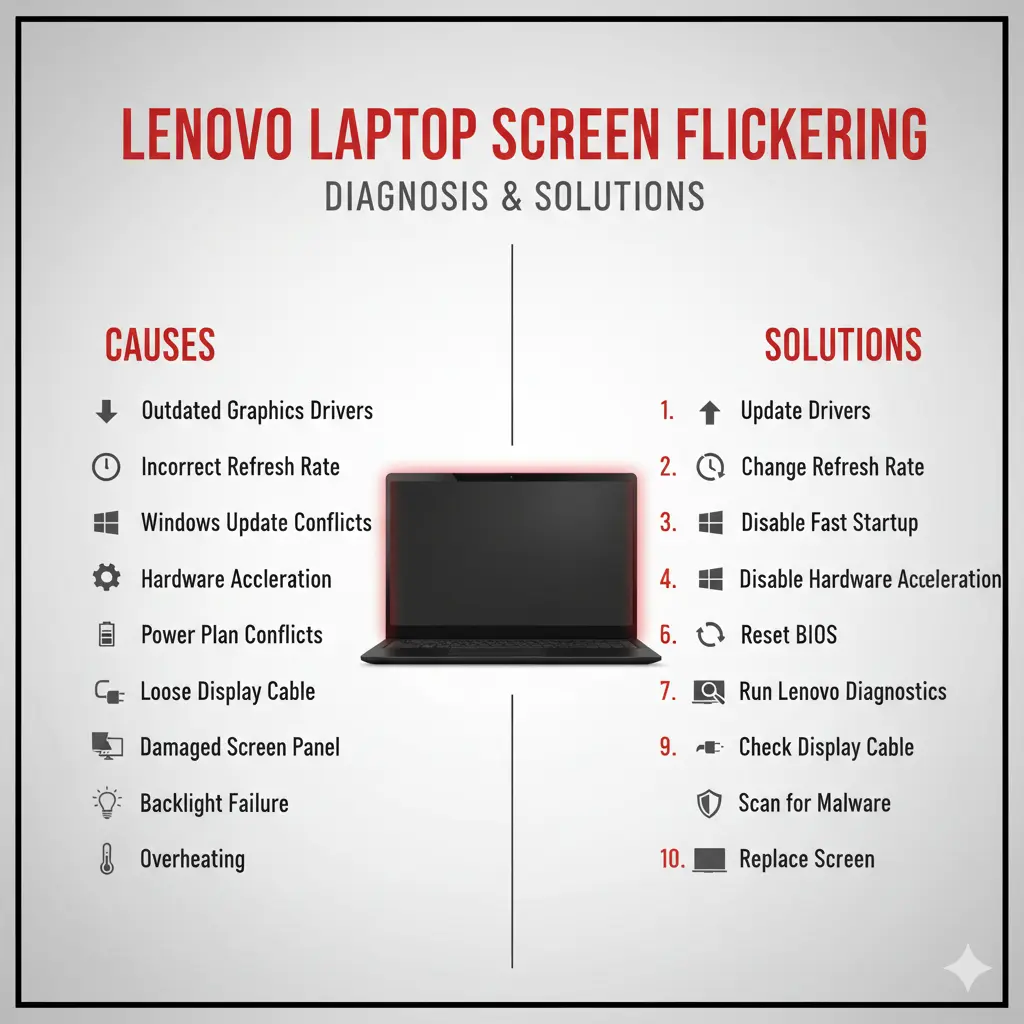
Outdated or Corrupted Graphics Drivers
Graphics drivers act as the communication bridge between your GPU and display. If these drivers are outdated, corrupted, or incompatible with recent Windows updates:
- The screen may flicker randomly
- Display flashes may occur during specific tasks or app usage
- Refresh rates may behave inconsistently, leading to instability
Driver issues often appear after Windows feature upgrades or major updates.
Incorrect Refresh Rate Settings
The refresh rate determines how many times per second your screen updates its image. Common refresh rates include 60Hz, 120Hz, 144Hz, and 165Hz.
If the refresh rate is unsupported or improperly configured, flickering may result. High-refresh-rate displays, such as those in Lenovo Legion gaming laptops, are particularly susceptible to this issue.
Windows Update Conflicts
Sometimes, a new Windows update can create compatibility issues with your GPU or drivers, particularly:
- Major Windows 11 upgrades
- Feature updates and patches
- Automatic driver updates
Hardware Acceleration Conflicts
Many modern applications, including Google Chrome, video editing software, Discord, and streaming platforms, use hardware acceleration to optimize performance. However, when the GPU or drivers conflict with these settings, screen flickering can occur.
Power Plan Conflicts
Certain power-saving modes can affect display performance, leading to flickering. Examples include:
- Automatic brightness changes
- GPU throttling while on battery or charging
- Flickering triggered by switching between power modes
Loose Display Cable
The laptop screen connects to the motherboard through a thin ribbon cable hidden inside the hinge. Over time, this cable may loosen, causing:
- Flickering when moving the lid
- Intermittent display cutouts
Damaged Display Panel
Physical impact, wear-and-tear, or aging can cause the screen panel to malfunction, resulting in:
- Flickering
- Color distortion
- Horizontal or vertical lines
- Backlight Failure
The LED backlight illuminates your screen. If the backlight becomes unstable or begins to fail, the display may dim, flash, or flicker.
GPU Overheating
High-performance or gaming laptops may experience screen instability when the GPU overheats during intensive tasks.
High Refresh Rate Displays & Flickering Issues
Modern Lenovo laptops—especially gaming models—now come with 144Hz, 165Hz, or even 240Hz displays. While these improve smoothness, they also increase the chances of flickering when:
- Drivers aren’t optimized
- Power settings switch frequently
- Apps don’t support high refresh rates
In 2026, many users report that locking the refresh rate to 60Hz temporarily helps diagnose issues before applying permanent fixes.
Quick Diagnostic Test (Software vs Hardware)
Before attempting repairs, you can perform a quick diagnostic to distinguish between software and hardware issues.
Open Task Manager
- Press Ctrl + Shift + Esc to open Task Manager
- Observe the flicker:
- Task Manager flickers along with the screen → Likely a hardware issue
- Task Manager remains stable, but the screen flickers elsewhere → Likely a software problem
Connect an External Monitor
Use an HDMI or USB-C connection to check if the problem persists on an external display.
| External Monitor Result | Diagnosis |
| Works perfectly | Laptop screen or internal hardware problem |
| Also flickers | GPU, graphics driver, or software issue |
Proven Fixes for Lenovo Laptop Screen Flickering
These solutions are widely recommended by technicians and Lenovo support specialists.
Update Graphics Drivers
Outdated graphics drivers are the leading cause of screen flickering.
Steps:
- Open Device Manager
- Expand Display Adapters
- Right-click your GPU → Update Driver
Pro Tip: Always verify driver compatibility with your specific version of Windows.
Change Refresh Rate
An incorrect refresh rate can trigger flickering, particularly in high-performance displays.
Steps:
- Open Settings → System → Display
- Click Advanced Display Settings
- Select the recommended refresh rate
Disable Fast Startup
Fast Startup can cause unexpected glitches, including flickering.
Steps:
- Open Control Panel → Power Options
- Click Choose what power buttons do
- Disable Fast Startup
Update Windows
Ensuring that your operating system is fully up-to-date maintains driver compatibility and overall system stability.
Steps:
- Open Settings → Windows Update
- Install all available updates
Disable Hardware Acceleration
Applications that leverage hardware acceleration can conflict with GPU drivers.
Example – Google Chrome:
- Open Settings → System
- Turn off Hardware Acceleration
- Restart the browser
Reset BIOS Settings
Resetting the BIOS ensures proper initialization of all hardware components.
Steps:
- Restart your laptop
- Enter BIOS (F2 or Delete)
- Select Load Default Settings
Run Lenovo Diagnostics
A Lenovo laptop might surprise you with hidden checks inside. These tests quietly spot broken parts on their own. When something fails, the system knows how to point it out. Hidden under the surface, answers appear without asking twice.
Steps:
- Restart the laptop
- Press F10/F12 to access diagnostic
- Run Hardware Diagnostics
Check Display Cable
When the screen flashes during lid movement, perhaps the display cable isn’t seated properly. Getting it checked by a technician helps prevent further issues.
Scan for Malware
Flickering might start when harmful software pushes the graphics processor too hard. A glitchy screen could mean nasty apps are hogging power behind the scenes. Overloaded hardware sometimes stutters, especially if sketchy programs run wild.
- Flick on F10 or hit F12 when you need checks. What shows up then helps spot hiccups
- Perform a full system scan
Replace the Screen Panel
When nothing else works, maybe the screen itself is broken
| Laptop Type | Screen Replacement Cost |
| Budget | $70 – $120 |
| Mid-range | $120 – $200 |
| High-end | $200 – $400 |
Lenovo Laptop Series Most Affected by Flickering
Different series face distinct flickering issues:
| Lenovo Series | Common Flickering Cause |
| IdeaPad | Budget panel instability |
| ThinkPad | Driver or docking station conflicts |
| Legion | High refresh rate conflicts |
| Yoga | Touchscreen driver issues |
| LOQ | GPU driver glitches |
Not the priciest option around – yet screen wobbles pop up more than once. IdeaPad machines stretch value thin when it counts.
How to Prevent Lenovo Laptop Screen Flickering
- Regularly update graphics drivers
- Avoid unsupported refresh rates
- Keep the laptop well-ventilated; consider cooling pads
- Update BIOS firmware as recommended by Lenovo
- Be gentle when using the computer. Sudden motions of the screen cover can cause harm. Moving it too fast might lead to damage over time. Careful handling prevents issues down the line
Pros and Cons of Lenovo Laptop Displays
| Pros | Cons |
| Good color reproduction on IPS panels | Budget panels prone to flicker |
| High refresh rates for gaming | High refresh rate requires driver updates |
| Reliable drivers on business laptops | Touch laptops may face driver conflicts |
| Wide resolution options | Older laptops may degrade over time |
When to Visit a Lenovo Service Center
Seek professional assistance if:
- The screen flickers even in the BIOS
- Persistent lines, blackouts, or display artifacts appear
- Flickering worsens when moving the lid
- The external monitor works normally, but the laptop screen does not
FAQs
A: Commonly caused by outdated drivers, incorrect refresh rate, or power conflicts.
A: Yes. Certain updates may install drivers incompatible with your GPU.
A: Yes, particularly in gaming laptops or under heavy workloads.
A: Not necessarily. Many cases are software-related and fixable.
A: Yes. Ribbon cables inside the hinge can loosen over time, affecting screen stability.
Conclusion
Screen flickering on a Lenovo laptop might seem complex at first—but in most cases, the solution is surprisingly simple. From updating graphics drivers to adjusting refresh rates or disabling conflicting features, small changes often deliver big results.
The key is Diagnosing correctly first—knowing whether the issue is software or hardware saves time, money, and frustration.
If the problem persists after applying all fixes, it may point to deeper hardware concerns like a faulty panel or loose internal cable—at which point professional repair becomes the safest option.