Introduction
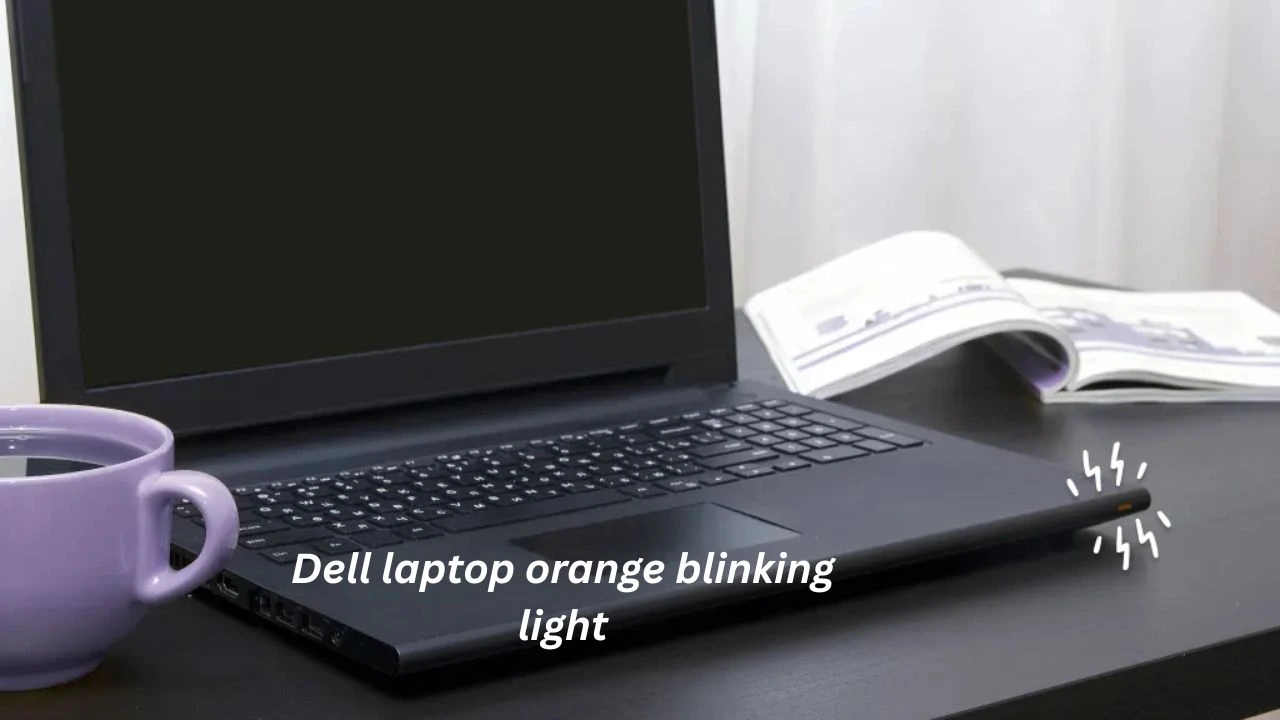
That blinking orange glow on your Dell Laptop might catch you off guard.Dell laptop orange blinking light. Still, there’s logic behind the flash. Light patterns show up by design, never at random. These signals help spot issues fast, cutting out guesswork. Each flicker tells a story of what could be wrong inside.
Most times, blinking lights point to hidden problems inside the machine – maybe the battery is dying, memory acts up, the BIOS got scrambled, the tiny CMOS power cell ran out, or something on the main board went quiet. This walkthrough shows what each flash means, walks through fixes one at a time, and brings in answers that match your exact device, helping you fix things right without guessing.
What You Will Learn in This Guide
This guide opens up clear views on what matters most. Inside every section lies a chance to see things differently. What follows shares only what needs saying. Each part connects without forcing links between ideas.
- The meaning of Dell laptop orange blinking lights
- How to interpret Dell LED blink codes accurately
- A structured, stepwise troubleshooting approach
- Solutions tailored for Inspiron, XPS, and Latitude series
- Indicators for when parts need replacement
- Preventive measures to extend laptop longevity
- Frequently asked questions about blink codes
Starting here, new users can follow a clear path to spot and fix physical issues on Dell laptops without stress or extra costs piling up quickly. Most find it easier than expected once they begin noticing patterns in how problems show themselves across different models.
Why Your Dell Laptop Displays a Blinking Orange Light
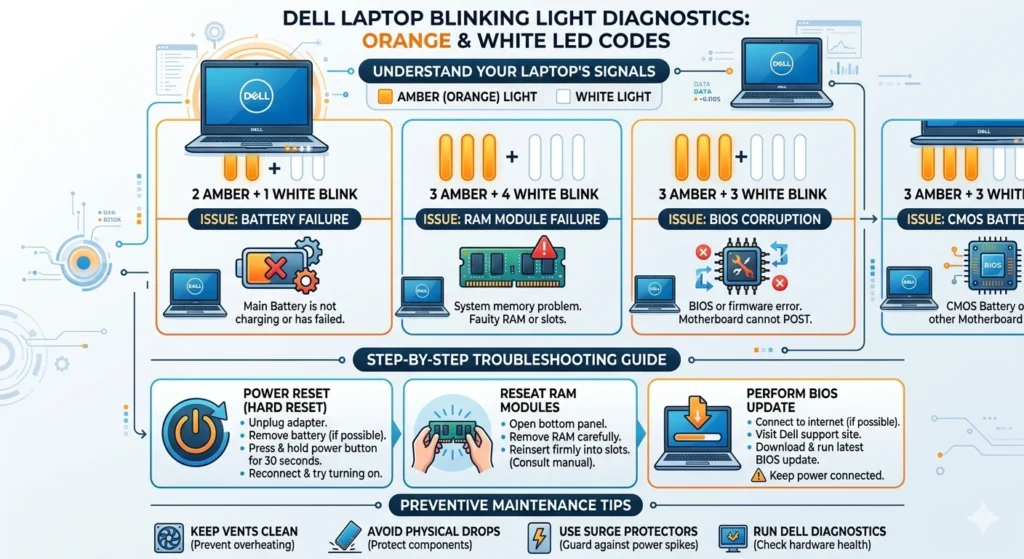
Flashing orange or amber? That’s your Dell talking during startup. When power hits, the machine runs tests – silent, internal scans of vital parts. Lights blink if something trips up; no sound here, just pulses in code. Trouble shows through patterns: amber pairs with white, each flicker a clue. Not random. Each sequence points right where it hurts.
When lights flash in a certain way, they tell you what might be wrong – no need to open up the machine right away. Because of how these signals work, someone who does not know much about computers can still figure out where trouble could start, cutting down on random tries.
Common Meanings of the Orange Blinking Light
Most time,s an amber light on a Dell laptop points to trouble somewhere inside – maybe power, maybe hardware acting up
- A sudden flicker on the screen might mean power trouble. Power cuts out even when plugged in. Sometimes it works, sometimes nothing happens at all. A shaky connection shows up after minutes or hours. The machine runs only with the cord attached. No reserve kicks in once unplugged. Charging pauses for no clear reason. Energy drains fast, then slower, then stops. Plugging back does not always help. The adapter feels warm but delivers little.
- Faulty memory could stem from loose modules sitting incorrectly in their slots. A glitch might show up when the system struggles to hold data correctly. Sometimes, just reinserting the piece fixes what seemed broken. Other times, replacement becomes the only path forward. Physical wear often hides behind sudden crashesthat people don’t expect.
- Faulty CMOS settings might come from scrambled firmware. A stale BIOS version could also be the reason. Instead of working right, the system stumbles at startup due to these glitches. Power loss in the BIOS battery often plays a part, too.
- A glitch in the motherboard might shut everything down fast. Core parts failing can stop a system without warning. Problems like these go beyond simple fixes. When hardware inside breaks, replacement often becomes unavoidable. These are not minor hiccups – they strike at the machine’s foundation.
How it reads hinges on how the lights flash – amber versus white, counted out in bursts. Getting those patterns right makes all the difference when figuring out what’s wrong.
Understanding Dell LED Blink Codes (Amber + White Patterns)
A flash pattern on Dell machines – like those in the Inspiron, XPS, or Latitude lines – usually means the same thing across models, even if the pauses between blinks differ just a bit here and there. Still, each series keeps its signals close to the others in how they speak through light.
Key principles:
- A yellow flash shows up before anything else. That’s how you spot the core issue right away.
- A flash of white shows next: highlights exactly which small part is involved.
Blink counts need attention. A short break often appears between code repeats, which might trip you up when tallying fast. Watch closely.
Dell Blink Code Reference Table
| Amber Blinks | White Blinks | Probable Issue | Component Impacted |
| 1 | 1 | TPM failure | Security chip |
| 2 | 1 | CPU fault | Processor |
| 2 | 2 | BIOS corruption | Firmware |
| 2 | 3 | RAM failure | Memory |
| 2 | 5 | CMOS battery dead | BIOS battery |
| 3 | 1 | Extended CMOS fail | BIOS battery |
| 3 | 2 | GPU / PCI failure | Graphics/PCI |
| Continuous amber | — | Battery not detected | Main battery |
| Amber + white continuous | — | Unsupported adapter | Charger |
This table allows users to identify the exact cause of an issue by matching blink patterns with corresponding components.
Top Causes of Orange Blinking Lights
Battery or Charging System Issues
A flickering amber light often points to issues with power storage or how it gets refilled. Sometimes the source isn’t clear, yet energy supply troubles show up more than anything else. When stored juice runs low or fails to refill properly, signals tend to turn amber. Power delivery hiccups reveal themselves this way almost every time. Rarely is it something beyond those two linked causes.
Typical causes include:
- Battery units lose strength over time. Old parts work less well. Worn components fail sooner.
- Cells weaken with age. Used-up pieces deliver poor results
- Defective AC adapter
- Damaged charging cable or laptop port
- A faulty electrical connection that slips out now and then
A flicker of amber light appears when the laptop struggles to get steady power. This signal points to possible issues in how electricity is being supplied. The machine uses that color to warn that there might be something wrong with charging.
BIOS or Firmware Errors
When a laptop powers on, the BIOS handles basic tasks. It links physical parts with software running above them. This firmware makes sure everything speaks the right way. Without it, communication breaks down early.
Potential issues:
- Corrupt or outdated BIOS
- False hardware error signals
- Boot failures or instability
When the system shows blink codes, a BIOS update might clear them if they stem from odd firmware behavior.
RAM (Memory) Problems
Faulty memory modules often cause error patterns – such as two yellow flashes followed by three clear ones. Sometimes it’s just a loose fit inside the slot that sets off these signals. Not snapping fully into place leads to communication hiccups. Lights flash in sequence when the system fails to recognize installed RAM correctly. Misaligned chips confuse the startup process, resulting in coded responses.
Symptoms:
- Blank or no boot screen
- System crashes
- Continuous blinking
A fresh start often helps when RAM acts up – pulling it out, then putting it back, can clear the problem. Sometimes, just a new module does the trick instead.
CMOS Battery Failure
Fresh power gone, the CMOS battery still holds the BIOS details. While unplugged, that small cell keeps memory alive. Without it, settings would vanish each time. It runs quietly in the background, doing its job. Even during long shutdowns, configuration stays put. A tiny part, yet crucial for a smooth startup.
Typical blink codes:
2 amber + 5 white
3 amber + 1 white
When the CMOS battery dies, expect lost configurations, wrong clock readings, and then boot checks that stall. Swapping it out costs little – it usually fixes the issue without extra steps.
Motherboard / Critical Hardware Failures
When key parts like the motherboard stop working properly, problems multiply – blink signals pop up one after another. A single fault might spark several alerts, flashing in sequence without pause.
Indicators:
Multiple blink patterns
The laptop fails to start entirely.
A correct label often needs a trained eye to spot. Most times, only someone with experience can tell what’s really going on.
Step-by-Step Troubleshooting Guide
Start by tackling each step one at a time, so you can fix the problem on your own. Since order matters here, move forward only when the current part is clear. Because skipping ahead might cause confusion, stay focused on what’s in front of you now. When done right, this path often leads to success without help from experts.
Perform a Power Reset
A sudden stop lets go of leftover current, waking up the hidden pathways inside. Power fades out, then returns – components reawaken on their own terms.
- Power fades out, then returns – components reawaken on their own terms.
- Close the lid of the computer
- Disconnect the AC adapter
- Start by taking out the battery, but only if it can be removed. Otherwise, leave it alone.
- Hold down the power button, keep it pressed for half a minute
- Start by sliding the battery back into place. After that, plug in the power cord
- Power on the laptop
- Most times, that fixes short-lived glitches behind blinking signals.
This often clears transient errors causing blink codes.
Test with a Known-Good ChargerA flickeringg amber light often points to a weak or uneven power supply. Power hiccups show up this way more than people realize.
Checklist:
- Use a Dell-certified AC adapter
- Match the correct wattage (e.g., 65W, 90W, 130W)
- Avoid third-party adapters, as they may trigger error codes
Fake chargers can cause warning messages on your screen. Not every cable works the same way under pressure. Some accessories misbehave without showing why. Stick to trusted brands if problems start appearing. Unknown parts often lead to system alerts being late.r
Reseat RAM & Battery
A loose memory stick might trick the system into flashing the wrong signals. Sometimes, a power cell not fully clicked in does the same thing.
Procedure:
- Power off the laptop
- Remove battery
- Open the RAM compartment
- Carefully remove RAM modules
- Clean contacts gently
- Push back into place with steady pressure, then piece it together again
Touch a metal part of the computer case before starting. That was why any built-up charge flows away safely. A small strap on your wrist works just as well, linking you to bare metal. Static can wreck parts without warning. Doing this simple step cuts the risk sharply.
Update BIOS
Updating BIOS can resolve errors caused by corrupted firmware.
- Firmware glitches might stop acting up once the BIOS gets a refresh.
- Visit Dell Support
- Enter your Service Tag
- Grab the newest BIOS update file
- Follow the instructions to update safely
Common Error Patterns + Fixes by Dell Model
Dell Inspiron Series
| Pattern | Meaning | Recommended Action |
| 2 amber + 3 white | RAM failure | Reseat or replace RAM |
| 3 amber + 2 white | GPU/PCI error | Professional diagnostics |
| Continuous amber | Battery not detected | Replace battery |
XPS Dell Series
| Pattern | Meaning | Recommended Action |
| Continuous amber | Battery not detected | Replace battery |
| Amber + white continuous | Unsupported adapter | Use a genuine Dell charger |
| 2 amber + 2 white | BIOS corruption | Update BIOS |
Dell Latitude Series
| Pattern | Meaning | Recommended Action |
| 2 amber + 5 white | CMOS battery dead | Replace the CMOS battery |
| 3 amber + 1 white | Extended CMOS failure | Replace CMOS |
| 1 amber + 1 white | TPM failure | BIOS security reset |
When to Replace Parts
Battery
Indicators:
- Continuous amber light
- The laptop does not charge
- Battery health reads 0% in BIOS
- When disconnected from power, the laptop turns off right away
Action: Replace with a Dell-certified battery.
AC Adapter
Indicators:
- The LED blinks when charging
- Amber + white continuous blink
- Voltage mismatch
- Adapter overheats
Try a different Dell charger instead. Swap it out should the current one fail.
RAM
Indicators:
- Blink code patterns like 2 amber + 3 white
- Frequent crashes or beeping
- No display signal
Action: Replace with compatible modules.
CMOS Battery
Indicators:
- Date/time resets at reboot
- BIOS settings revert
- Blink code corresponds to CMOS codes
Action: Replace CMOS battery.
Motherboard
Indicators:
- Multiple error codes
- The Laptop fails to start
Action: Professional technician required.
Dell Blink Code Symbols — Quick Summary
- Amber Only Indicates Power or Battery Problems
- Amber plus White means hardware check
- Continuous amber battery not detected
- The steady glow of amber mixed with white means the charger does not work right. The device sees it, but cannot use the power properly.y
- Repeating Patterns Suggest Memory Or System Firmware Problems
Preventive Maintenance Tips
- Regular BIOS updates
- Clean cooling vents and fans frequently
- Use only genuine Dell accessories
- Avoid overheating
- Monitor battery health
Ahead of trouble, upkeep cuts down flickering lights while stretching how long your laptop lasts. Though small, consistent care shapes reliability far beyond just fixing what’s broken.
FAQs
A: Likely a battery or charging issue. Use a known-good charger and check battery health in BIOS.
A: Usually related to BIOS or CMOS battery failures, often paired with white blinks.
A: Not always. Minor firmware or battery health issues may trigger blinking. Check BIOS and perform a power reset.
A: Yes. Start with external checks such as charger replacement, power reset, and BIOS updates.
A: Count amber and white flashes carefully. Dell’s blink code table identifies the faulty component.
Conclusion
A flicker in orange on your Dell laptop? That’s by design, meant to speak up when something’s off. Read those flashes right, they tell you what’s wrong – no guesswork needed.
Fixing problems becomes doable when following clear steps one at a time, especially if real Dell components are used. Begin simply – try restarting the power, check with an official charger, update the BIOS first instead of opening up the device. Knowing these things means Blinking error lights won’t feel confusing anymore.