Introduction
Ablackscreenonan HP Laptop can feel maddening. HP laptop blank screen. Just seconds before, everything worked fine – now nothing shows. The machine seems alive: keys glow faintly, vents hum softly, familiar chimes play at boot. Yet the display stays empty, offering no clue. Is it a small system hiccup? Or something deeper inside broken? That silence from the monitor makes guessing nearly impossible.
Luckily, many times a black screen can be fixed right at home, no expert skills needed. A clear sequence of steps helps anyone spot what is wrong and then fix it well. Here’s what we cover next.
- Why does your HP laptop screen go blank
- How to differentiate between software and hardware causes
- Stepwise remedies from simple to advanced levels
Whether it’s a basic model or a high-end machine, every HP laptop works with these steps. Start here instead of calling support – pinpointing the problem becomes simpler, and then solving it happens quicker than waiting around for outside help.
Explanation
Finding clarity here comes down to one thing – really getting what’s next. This piece walks through each part without rushing ahead. Each idea builds on the last, yet stands clear by itself. Confidence grows when pieces fit, not just stack up. The goal? Knowing where you stand by the time words run out
Frequent reasons for blank displays
Safe methods to test your laptop
What each remedy addresses and when to apply it
When professional assistance is necessary
A good place to start is looking at clues pointing to a black display problem with your HP laptop.
Signs Your HP Laptop Has a Blank Screen Problem
Spotting the signs clearly comes first, before any attempt to solve things. Getting the issue right at the start avoids wasted effort, simply because confusion grows when guesses replace clarity.
Common Symptoms
- Laptop powers on, but the display remains black
- Faint glow spreads across keys, though the display stays blank
- Sound comes from spinning parts inside – yet the screen stays dark. A hum sits in the air where pictures should be. Gears turn without showing anything at all. The machine speaks through whirring, not visuals. Light fails even as movement continues behind the case. What you hear does not match what you see because there is nothing to see
- The screen stays blank even after logging into Windows
- Cursor visible on a black background
Symptom Table
| Symptom | Possible Cause | Quick Diagnostic Test |
| Laptop powers on, screen black | Graphics driver failure, display panel defect | Connect an external monitor |
| Keyboard lights on, no display | BIOS corruption, firmware error | Reset BIOS settings |
| Black screen after login | Driver conflict, Windows error | Boot into Safe Mode |
| Blank screen with cursor | System hang, driver malfunction | Restart and update GPU drivers |
Main Causes of HP Laptop Blank Screen
A dark screen on an HP laptop often comes from one of five main issues. Figuring out which one is key to picking the right fix. Different problems show different clues – some obvious, others less so. Power supply trouble might be silent, but it stops everything cold. A loose cable inside can cut visuals without warning. The display itself sometimes fails after long use. Graphics glitches mislead by showing signs that vanish suddenly. Each cause needs its own approach, no shortcuts.
Graphics Driver Issues
When your computer talks to the monitor, the graphics driver helps them understand each other. Without a working, up-to-date match between Systems, what shows on screen might break or look wrong.
Common triggers:
- Windows updates
- Manual installation of incorrect drivers
- Sudden system crashes
Symptoms of driver issues:
- Blank screen during startup
- Flickering followed by a black screen
- The external monitor shows a display while the laptop screen remains dark
Example Scenario:
Yesterday, John installed the latest Windows update. His HP laptop nowturnson, yetshowsnothingonscreen. However, when using another display, everything appears normal. Most likely, thegraphics driverhasgonewrong.
BIOS Corruption
A flicker of life appears when you press the button, yet nothing shows up on the display. That silent black panel often points to a scrambled BIOS – the system failing to whisper instructions to components.
Causes of BIOS corruption:
- Failed BIOS updates
- Power outages during firmware flashing
- Firmware bugs
Signs of BIOS issues:
- No logo appears during boot
- The screen remains black before Windows starts
- Lights or beep codes occur without a display
RAM Problems
A glitchy memory stick, or one that is not pushed fully into place, might stop your laptop from starting up.
Symptoms:
- No HP logo on startup
- Black screen despite moving fans
- Random system freezes
Try taking out the memory modules, then putting them back in – this step fixes many startup problems. Sometimes a loose connection is all it takes to stop things from working right.
Display Panel Failure
A glitch might live in the display, though everything else runs just fine.
Indicators:
- The external monitor works normally
- Laptop display remains dark
- No backlight or brightness response
Loose or Damaged LCD Cable
Falls or years of handling can jostle free – even harm – the wire tucked inside that joins the screen to the main board.
The screen stays dark even though the machine turns on. Yet the power light confirms it is running. Still, no image appears up front. While fans spin normally inside. Even so, visuals only show elsewhere. Though the built-in panel remains blank throughout.
Quick Fixes for an HP Laptop Blank Screen
Most of these fixes work without tools, need little effort, yet handle frequent issues well.
Perform a Hard Reset
Restarting the machine wipes out short-term glitches stuck in its physical parts, plus software layers beneath.
- Unplug the charger and all peripherals.
- Remove the battery if removable.
- Hold the power button for 15 seconds.
- Reconnect the battery and peripherals, then power on.
Power drains away when the system restarts. A fresh start clears hidden glitches inside the controller.
Connect an External Monitor
A second display can show where the problem really is – screen or machine. Sometimes it’s not the laptop, just what you’re looking at. Try plugging in elsewhere to see if things change. The fault might be hiding in plain sight. Watching how images appear externally tells a different story. If it works there, your eyes weren’t lying. One part talks while another stays silent. See which one answers back.
Interpretation:
- External monitor displays correctly → internal screen or cable issue
- External monitor is also blank → GPU or motherboard problem
A solid test begins with HDMI. Or try DisplayPort – both work well. Either one gets the job done clearly. Pick what you have nearby.
| External Monitor Result | Interpretation |
| Works fine | Laptop screen or cable issue |
| Blank too | GPU or system problem |
Use Display Toggle Shortcut
Some HP laptops require manually switching between screens.
Shortcut: Press Fn + F4 (or the display icon key) to cycle between:
- Laptop screen
- External monitor
- Both screens
Sometimes, the system is sending video output to the wrong display.
Boot Into Safe Mode
Safe Mode loads minimal drivers, isolating software problems.
Steps:
- Restart the laptop.
- Press F8 or Shift + Restart.
- Choose Safe Mode.
Whenthe screenfunctionsduringSafe Mode, itprobablypointstoa software clash instead of hardware trouble.
Advanced Fixes for HP Laptop Blank Screen
If the quick fixes do not resolve the issue, advanced troubleshooting may be necessary.
Update or Roll Back Graphics Drivers
Both outdated and newly installed drivers can trigger display issues.
Steps:
- Open Device Manager
- Expand Display Adapters
- Right-click GPU driver → Update or Rollback
- Restart laptop
Recover BIOS
HP laptops include a built-in BIOS recovery feature.
Steps:
- Turn off the laptop
- Press and hold Windows + B
- While holding, press Power
- Keep holding keys for 5–10 seconds
- Follow on-screen instructions
Note: BIOS recovery can restore startup functionality but should not be interrupted.
Reseat RAM Modules
Loose RAM may cause boot failures.
Steps:
- Turn off the laptop
- Remove the back cover
- Carefully remove RAM sticks
- Reinsert firmly
- Close the back cover and restart
Hardware Repairs
If software fixes fail, physical components may be defective.
Possible replacements:
- LCD panel
- Display cable
- RAM modules
- Motherboard
Recommendation: Seek professional service for hardware repairs to avoid further damage.
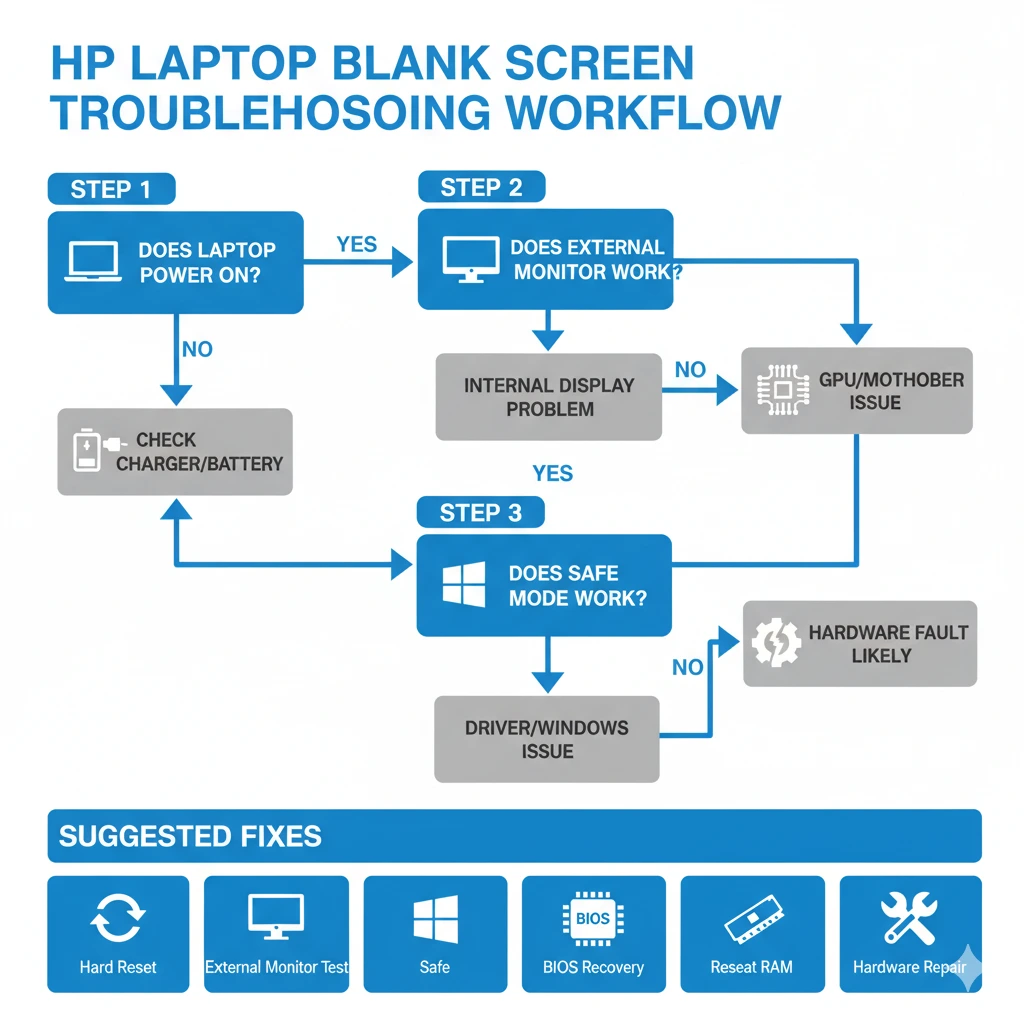
Structured Troubleshooting Flowchart
Use this step-by-step workflow to systematically identify the problem:
- Does the laptop power on?
- No → Check charger & battery
- Yes → Proceed to next step
- Does the external monitor work?
- Yes → Internal display problem
- No → GPU or motherboard issue
- Does Safe Mode work?
- Yes → Driver or Windows issue
- No → Likely hardware fault
This methodical approach helps quickly isolate the root cause.
Examples of Blank Screen Situations & Solutions
Black Screen After Windows Update
- Symptoms: Blank screen after power-on
- Quick Test: External monitor works
- Likely Cause: GPU driver issue
- Solution: Boot into Safe Mode → Rollback driver
Screen Dead but the external monitor works
- Symptoms: Laptop display is black, external monitor is functional
- Likely Cause: Internal screen or cable problem
- Solution: Reseat the cable or replace the screen panel
No Display at All
- Symptoms: Laptop and external monitor show nothing
- Likely Cause: BIOS or motherboard failure
- Solution: Attempt BIOS recovery; if unsuccessful → service center
Prevention Tips
Maintain laptop health with these simple habits:
Keep graphics drivers and system software updated
Avoid forced shutdowns or abrupt power-offs
Handle the laptop carefully to prevent drops or shocks
Update BIOS only when necessary
Keep the workspace clean and dust-free
Regularly back up important files
Pros & Cons of Common Fixes
| Fix | Pros | Cons |
| Hard Reset | Quick, free | Temporary solution |
| External Monitor Test | Easy diagnosis | Does not fix internal display |
| Safe Mode | Pinpoints driver issues | May be technical for beginners |
| BIOS Recovery | Fixes startup | Risk if interrupted |
| Reseating RAM | Simple hardware fix | Requires careful handling |
| Hardware Replacement | Permanent fix | Can be costly |
FAQs
A: Usually due to graphics driver corruption, RAM failure, BIOS problems, or a damaged display cable.
A: Yes — especially if a previous BIOS update was interrupted or corrupted.
A: Often caused by GPU driver conflicts or a problematic Windows update.
A: Professional repair may be necessary, possibly involving the replacement of the display, motherboard, or RAM modules.
Conclusion
A blank screen on an HP Laptop can feel like a dead end, yet fixes exist more often than not. Step by step, through clear methods shown here, your path forward now has light
Common causes of blank screens
How to differentiate software vs. hardware issues
Prevention strategies to avoid future issues
From a full restart plus checking an outside screen, move toward booting safely, then tweaking drivers. When needed, try reviving the system firmware or inspecting physical parts. Following steps like these cuts down wasted hours, reduces stress, saves cash, and helps your machine last longer.
Most HP laptops keep working well over time when looked after properly. Updates applied on schedule help avoid sudden blackouts during work. Simple habits go a long way in preventing screen failures later. Protection comes not just from software fixes but also steady care routines. Years of reliable use often follow basic maintenance steps done consistently.