Introduction
Your Laptop Holds private data now, way beyond basic tools. Dell laptop data wipe tutorial. When aiming to pass it on, trade it in, fix issues, move to a new gear, or let someone else have it, removing documents alone won’t cut it. A fast wipe or erasing folders by hand leaves too much behind. This machine stores traces deeper than surface actions reach.
- Saved passwords alongside login details
- Financial records and banking details
- Photos you keep to yourself. Videos meant only for your eyes
- Confidential work documents
- Browser history and cached data
Hidden bits stick around inside storage zones long after you wipe or reformat them. Recovery software can still pull those pieces back using deep scanning tricks.
Explanation
This guide goes beyond just factory resets, while most articles stop there
- Deep insights into secure erasure techniques
- Advanced SSD-level wiping strategies
- BIOS and recovery-based solutions
- Professional-grade data destruction approaches
If you’re just starting out or already know your way around tech, this guide makes sure your data stays gone – no trace left behind by 2026. While some methods fade over time, what’s covered here holds up without question. Even if someone tries hard, recovery won’t happen. Security isn’t questioned because every step blocks comebacks. What gets wiped now stays that way well beyond next year.
What Does “Data Wipe” Really Mean?
A fresh start happens when every bit of saved info gets wiped out completely – no trace left behind. Gone means gone, not just hidden or tucked away somewhere dark. Even experts with high-tech gear can’t pull anything back once it’s truly erased. What was there before simply ceases to exist. Total removal isn’t about deleting; it’s making sure nothing lingers beneath the surface. Afterward, the space acts like it never held data at all.
Wiping it clean goes beyond removal – this erases traces completely.
Key Differences You Must Understand
| Method | What It Does | Security Level | Recoverable? |
| Reset (Keep Files) | Reinstalls OS | Low | Yes |
| Reset (Remove Everything) | Deletes user data | Medium | Sometimes |
| Clean Drive | Overwrites storage sectors | High | Very Hard |
| Secure Erase (SSD) | Firmware-level wipe | Very High | No |
Critical Insight
Even after a factory reset, the real information stays put– onlylinkstofilesgetwiped. Recovery tools might pull it back, thanks to how storage works behind the scenes.
When Should You Wipe Your Dell Laptop?
Most days you won’t need to wipe data – yet when specific situations arise, doing so matters a great deal.
Real-Life Use Cases
You should perform a complete data wipe if:
- Selling your laptop to another user
- Donating or gifting your device
- Recycling or disposing of old hardware
- Eliminating viruses, malware, or ransomware
- Fixing lagging or performance issues
- Protecting sensitive business or personal data
A choice? Only if you value control over your data. Wiping steps in when silence speaks too loud. Refusing it feels like leaving doors open on purpose.
Windows Reset (Beginner-Friendly Way)
This approach works best for regular people just going about their day. It skips complexity without sacrificing function.
Step-by-Step Instructions
- Open the Start Menu
- Navigate to Settings → Update & Security
- Click on Recovery
- Select Reset this PC → Get Started
- Choose Remove everything
- Select:
Start by deleting unnecessary files first. After that, wipe the drive completely. Begin again if something remains behind. Finish only when everything is gone. Proceed without skipping steps - Follow on-screen prompts
Process Breakdown
| Option | Speed | Security | Best For |
| Remove Files Only | Fast | Low | Personal reuse |
| Clean Drive | Slow | High | Selling laptop |
Fresh tip: Pick Clean the Drive every time – this goes further in wiping data clear. Instead of skipping it, make it routine; that extra step removes more traces than basic deletion alone.
Wipe Using Advanced Startup
Frozen machine or won’t turn on? This way gets things moving again.
Steps to Follow
- Hold down the Shift key while you restart. Wait until both actions happen together.
- Navigate to:
Troubleshoot → Reset this PC - Select:
Fix problems by starting fresh – try resetting your computer instead - Choose:
Clean the drive
Even when the operating system is damaged beyond access, this approach still functions.
Dell Factory Image Restore
Dell laptops include a built-in recovery environment for system restoration.
Steps to Use It
- Restart your laptop
- Press F12 repeatedly
- Select SupportAssist OS Recovery
- Click Factory Reset
- Follow the guided instructions
What This Method Actually Does
| Feature | Included |
| Removes files | ✅ |
| Restores Dell OS | ✅ |
| Deletes applications | ✅ |
| Secure wipe | ❌ |
Functionality comes back using this approach, yetcompletedata removalisn’tassured. Still, it works again – just not completely erased underneath.
Secure Data Wipe (Advanced & Professional Methods)
Focusing on top-level safety? These stronger Techniques matter most.
Clean Drive (Windows Built-in)
- Overwrites storage sectors
- Fewer hopes remain once things take that turn. Recovery slips further away under such conditions.
- Slower but safer
SSD Secure Erase (Best Method in 2026)
Right now, nothing works better than this approach. It just gets the job done without fail.
How It Works
- Uses internal SSD firmware commands
- Resets memory cells to factory state
- Fresh traces vanish when old files get cleared out. Stored bits disappear after a deep sweep takes place. Leftover pieces fade once the system resets fully.
- Eliminates data permanently
Most experts see this method as the top choice when clearing data. It stands out because it meets strict security rules. People trust it after years of consistent results. Security teams choose it again and again without question
Option C – Third-Party Tools
Popular tools include:
- DBAN (for HDD only)
- For hard drives alone, there’s DBAN
- Crucial Storage Executive
Comparison of Secure Wipe Methods
| Method | Drive Type | Security | Difficulty |
| Clean Drive | SSD/HDD | High | Easy |
| DBAN | HDD | Very High | Medium |
| SSD Secure Erase | SSD | Maximum | Advanced |
Factory Reset vs Data Wipe (Critical Comparison)
| Feature | Factory Reset | Data Wipe |
| Deletes files | ✅ | ✅ |
| Removes OS | ❌ | Optional |
| Prevents recovery | ❌ | ✅ |
| Best for selling | ❌ | ✅ |
| Security level | Medium | Very High |
Real-World Scenarios (What You Should Do)
Selling Your Laptop
Use:
- Clean Drive
- SSD Secure Erase
Nothing leaks out. Data stays locked away. No access points left open. Everything remains hidden by design
Laptop Running Slow
Use:
- Reset (Remove Everything)
Virus or Malware Infection
Use:
- Factory Reset OR Clean Installation
Business or Compliance Needs
Use:
- SSD Secure Erase
Required for strict data protection standards
Common Problems & Fixes
Reset Not Working
Solutions:
- Use Advanced Startup
- Reinstall OS via USB
- Use BIOS recovery tools
Recovery Partition Missing
Fix:
- Download Windows ISO
- Create a bootable USB
- Perform a fresh installation
Laptop Stuck During Reset
Fix:
- Force restart
- Perform a clean OS installation
Expert Tips (Boost Your EEAT Score)
Security Tips
- Remove linked accounts before wiping
- Disable encryption features
- Log out of all services
Backup Tips
- Store important files externally
- Use cloud storage solutions
Technical Tips
- Update BIOS firmware
- Leave the charger connected to the machine at all times
- Use verified tools only
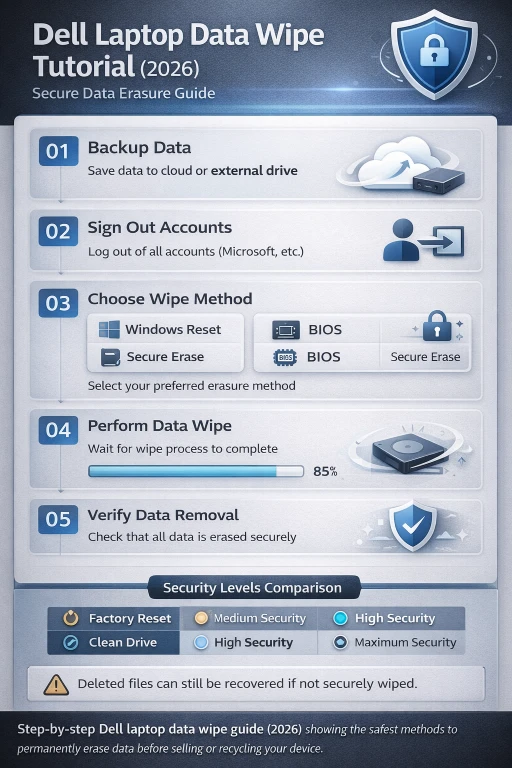
Complete Data Wipe Process Overview
| Step | Action | Tool |
| 1 | Backup data | External storage |
| 2 | Sign out of accounts | Microsoft |
| 3 | Choose method | OS/BIOS |
| 4 | Perform wipe | Reset/Secure erase |
| 5 | Reinstall OS | Bootable USB |
Pros & Cons of Data Wiping Methods
Pros
- Protects confidential information
- Prevents identity theft
- Improves system efficiency
- Essential before resale
- Eliminates malware completely
Cons
- Time-intensive process
- Permanent data loss risk
- Requires technical understanding
- Not reversible
FAQs
A: Yes. Data can often be recovered unless you use a clean drive or secure erase.
A: Basic reset: 30–60 minutes
Clean drive: 1–3 hours
SSD secure erase: 5–30 minutes
A: Always use Secure Wipe or Clean Drive
A: SSD Secure Erase is the safest method.
A: No. Windows built-in tools are enough for most users.
Conclusion
Cleaning a Dell Laptop goes beyond steps on a screen – it’s about locking down your secrets. Some think trashing documents or restarting the system wipes everything clean. Truth is, bits of data stick around inside the drive, hidden but reachable. These fragments can be pulled back by anyone who knows where to look.
When you hand off your gadget, leftover data might slip through. Files that should vanish could stick around without solid cleanup steps. Ownership changes get tricky when passwords, private notes, or photos remain hidden but reachable. A weak erase leaves room for others to dig up what was meant to disappear.
A fresh start might do the trick when speed matters most. Yet full protection demands more than a quick fix – specialized tools take care of what simple resets leave behind.
Start fresh with your Dell laptop by walking through these clear steps to move personal files. A clean slate comes easily when every trace of activity gets wiped away. Identity stays safe because nothing remains behind after the process finishes. Digital tracks vanish entirely once everything is properly erased. Confidence grows knowing each detail was handled without shortcuts.