Introduction
A black spot on a Dell Laptop screen is really bad. It is not something that looks bad; it is a sign that something is wrong inside the screen. If you do not do anything about it, the problem will get worse. Many people think that the black spot is because of some dust or a small problem with Windows.
They also think it might be an issue with the software. Most of the time, the black spot is because of a problem with the hardware. This can be because some of the pixels on the screen are dead, or maybe the screen got pressed hard and that damaged it. It could also be because the light behind the screen is not working properly or because there is a leak in the liquid that makes the screen work.
Explanation
The new Dell notebooks that are coming out in 2026 have great screens. They use kinds of screens, like IPS, OLED, Full HD 4K, and some of them even let you touch the screen. The thing is,s these screens can break easily. If you put too much pressure on them or if water gets in, or even if you just use them a lot, the screen can get damaged for good. The Dell notebooks’ screens are just not very strong.
Let us find some solutions and forget about the things that people say are true but are actually not true. We will look at solutions and also talk about the myths that people believe in, and then we will debunk these myths. Practical solutions are what we need to make our lives easier. Myths are things that we should not believe in. So we will debunk these myths. Focus on the practical solutions.
Why You Are Seeing a Black Spot on Your Dell Laptop Screen
A black spot never appears spontaneously. It is always symptomatic of internal damage in the display module. Understanding the screen’s layered structure is essential:
How Dell Laptop Screens Are Built
Most modern Dell displays consist of:
- Protective glass or plastic shield – an external layer that guards against scratches and minor impacts
- LCD or OLED pixel matrix – responsible for rendering colors on individual pixels
- Liquid crystal layer – manipulates light for image formation
- LED backlight system – illuminates pixels
- Display control circuitry – manages pixel response and signal transmission
If something happens to any of the layers on a screen, you will see spots, blotches, or dark patches on the screen. The layers are really important,t and damage to any of the layers can cause these problems. You will notice spots or dark patches on the screen when the layers are damaged.
What Is a Stuck Pixel?
A stuck pixel remains fixed on one color (red, green, or blue) and may appear black depending on the screen background.
Causes of Dead Pixels
- Manufacturing defects during production
- Aging of the panel over time
- Excessive localized pressure
- Overheating or thermal stress
Multiple adjacent dead pixels can coalesce into a noticeable black patch or blotch.
How to Verify Dead Pixels
- Display a completely white screen
- Cycle through red, green, and blue backgrounds
- Observe the black spot
- Spot never changing → hardware failure
- Spot changes or flickers → may be a stuck pixel
Physical Pressure or Impact Damage
Common Real-World Triggers
- Closing the lid with objects inside (earbuds, USB drives, pens)
- Carrying a laptop tightly packed in a bag
- Applying excessive pressure while cleaning the screen
- Minor drops or bumps
What Happens Inside the Screen
Pressure can rupture or distort the liquid crystal layer, producing:
- Ink-like stains
- Irregular blotches
- Spots that gradually expand over time
Backlight Malfunction or Uneven Illumination
Dell laptops utilize LED backlighting for screen illumination. Backlight issues may mimic black spots but exhibit different behavior.
Symptoms
- Dark patches are more visible at certain viewing angles
- Spot is more prominent on white or light backgrounds
- Uneven brightness across the display
Causes
- Aging LED components
Inconsistent power delivery - Separation between display layers
Loose Display Cable or Connector Issues
The display cable, typically routed through the hinge, may loosen or sustain minor damage.
Symptoms
- The black spot changes when opening or closing the lid
- Flickering near the affected area
- Temporary dark patches
This can often be repaired without replacing the entire screen.
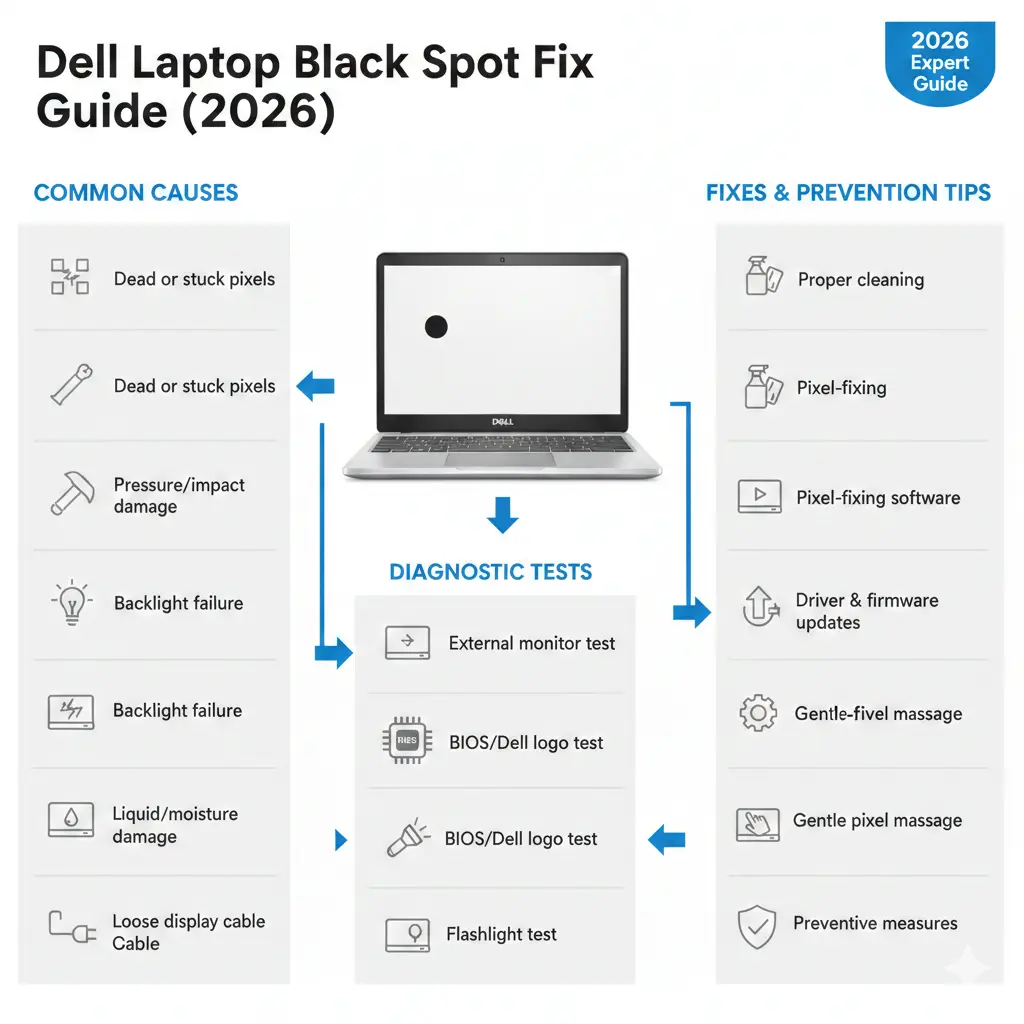
Diagnostic Tests — Identify the True Cause
A. External Monitor Test
- Connect your Dell laptop to an external monitor
- Observe the black spot
- Spot disappears → internal screen problem
- Spot visible → GPU or system-level issue (rare)
B. BIOS / Dell Logo Test
- Restart the laptop
- Observe the Dell boot logo
- Spot visible at BIOS stage → hardware-related
- Software cannot cause BIOS-level display defects
C. Flashlight Test
- Shine a flashlight at an angle on the black spot
- Image visible → backlight failure
- Fully black → LCD panel damage
Step-by-Step Fixes You Can Safely Try
Proper Screen Cleaning
Dust or smudges may appear as black spots.
Recommended:
- Microfiber cloth
- Screen-safe cleaner
Avoid alcohol, ammonia, or paper towels
Pixel-Fixing Software
- JScreenFix
- PixelHealer
Effective only for stuck pixels
Ineffective for dead pixels or pressure-induced damage
Gentle Pixel Massage
- Power off the laptop
- Use a microfiber cloth to apply very light pressure over the spot
When Screen Replacement Is the Only Real Solution
Screen replacement becomes necessary if:
- The black spot is expanding over time
- The spot appeared after pressure or impact
- External monitor test shows a normal display
- Pixel-fixing software fails
Dell Laptop Screen Replacement Cost (2026 Guide)
| Screen Type | Estimated Cost |
| HD (1366×768) | Low |
| Full HD (1080p) | Medium |
| Touchscreen | High |
| OLED / 4K | Very High |
Costs vary depending on model, country, and part availability.
Dell Warranty & Accidental Damage Explained
Covered:
- Manufacturing defects
- Factory pixel failures (limited coverage)
Not Covered:
- Pressure or impact damage
- Liquid spills
- Drops
Dell Accidental Damage Protection may cover screen replacement if previously purchased.
Repair vs Replace Decision Table
| Condition | Best Option |
| Single stuck pixel | Ignore or software |
| Growing black blotch | Replace screen |
| Backlight failure | Repair |
| Old laptop + high cost | Replace laptop |
Preventive Measures — Protect Your Dell Screen
- Never close the lid with items inside
- Use padded laptop sleeves
- Clean gently with a microfiber cloth
- Avoid direct pressure during travel
- Keep liquids away from the screen
Pros & Cons of Fixing a Black Spot
Pros
- Restores usability
- Prevents further spread
- Extends laptop lifespan
Cons
- Replacement can be costly
- Limited warranty coverage
- DIY repair risks
FAQ
A: Yes, particularly if caused by pressure or moisture.
A: Only if it is a stuck pixel.
A: Conclusion: Expert Advice for Dell Users
A black spot on a Dell Laptop screen is never purely cosmetic. Causes range from dead pixel clusters and LCD pressure damage to backlight failure and internal contamination. Correct diagnosis saves money, prevents frustration, and ensures long-term usability.
- Small, stable spots → monitoring may suffice
- Spreading, pressure-induced spots → replacement is the only permanent solution
With this guide, you now possess expert-level insights, precise diagnostics, and realistic repair expectations — exactly what any Dell laptop user should know in 2026.